A PSA 10 is a virtually perfect card, centered within 55/45 on the front and 75/25 on the back. Here's what every PSA grade from 1 to 10 means, with PSA's own centering limits, qualifiers, half grades, fees and what each grade is worth.
A PSA 10 is a virtually perfect card, centered within 55/45 on the front and 75/25 on the back. Here's what every PSA grade from 1 to 10 means, with PSA's own centering limits, qualifiers, half grades, fees and what each grade is worth.
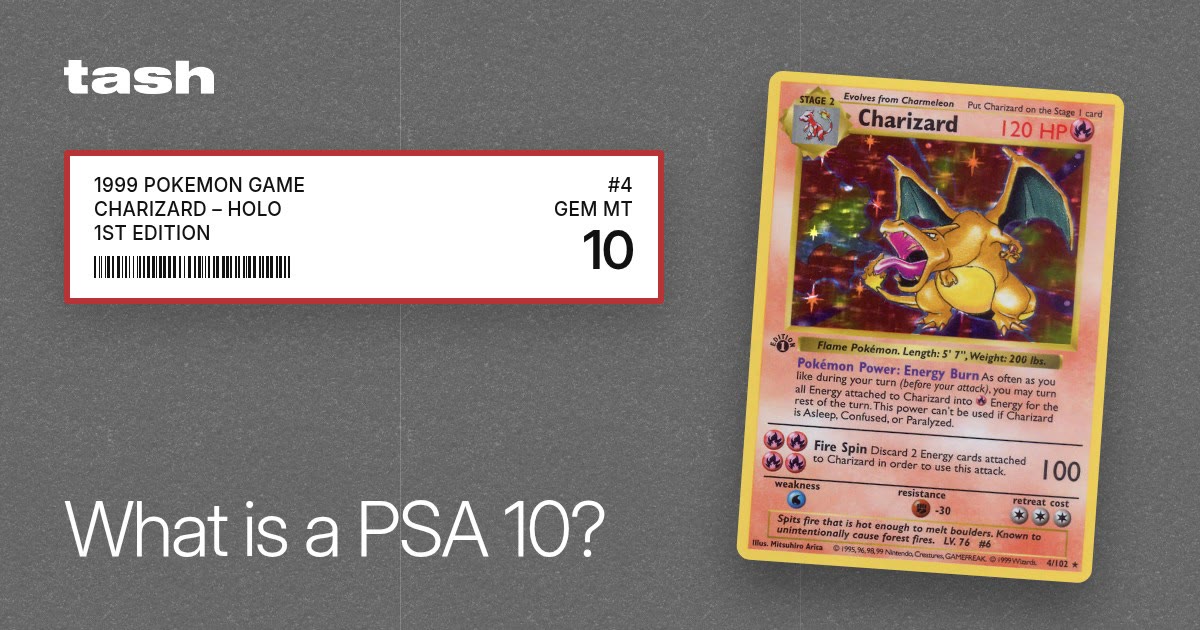
A PSA 10 is the highest grade Professional Sports Authenticator gives a trading card. PSA, the largest grading company in the world, calls it Gem Mint and defines it as “a virtually perfect card”: four sharp corners, sharp focus, full original gloss, no staining, and centering within about 55/45 on the front and 75/25 on the back.
Almost nothing moves a card’s price more than that one number. In October and November 2026, a 1999 Base Set Charizard sold for a median of about $3,350 as a PSA 9, while PSA 10s sold for $32,900 to $40,400. One step up the scale, roughly ten times the money.
Below is every PSA grade, taken from PSA’s own published standards, plus the parts of the label most guides skip (qualifiers, and the codes PSA uses when it won’t grade a card) and what each grade is actually worth.
Who PSA is and why its grade matters
PSA opened in 1991 and has certified more than 65 million items since. In 2025 it graded about 19.3 million cards, 72% of everything the major companies graded that year, according to year-end figures from the tracker GemRate. It now gets through around 90,000 cards a day.
With that share, PSA’s grade is the one most prices are set against. Price guides, auction houses and investment indexes default to it, and at most grades the same card sells for less under another company’s label. The exceptions are at the very top, where a rival’s best grade, such as a Beckett Pristine 10, can beat a PSA 10. Our comparison of PSA, BGS, SGC and CGC goes through that gap card by card.
How PSA grades a card
PSA looks at centering, corners, edges and surface. Beckett usually prints a separate score for each of those on its label; PSA doesn’t. You get one grade for the card as a whole, and the weakest area usually sets the ceiling. Perfect corners won’t save a card with a scratch across the front.
PSA’s FAQ says at least two graders examine every card and have to agree before it’s sealed. The card then goes into a tamper-evident plastic case, the slab, with a label showing the card, the grade and a unique certification number.
Every PSA grade from 1 to 10
Centering is the only part of grading PSA puts in numbers. It’s the ratio of the borders on opposite sides: 50/50 is perfectly centered, and 60/40 means one border is noticeably wider than the other. The front and back have separate limits.
| Grade | Name | Front centering | Back centering |
|---|---|---|---|
| 10 | Gem Mint (GEM-MT) | about 55/45 | 75/25 |
| 9 | Mint (MINT) | about 60/40 | 90/10 |
| 8 | Near Mint-Mint (NM-MT) | about 65/35 | 90/10 |
| 7 | Near Mint (NM) | about 70/30 | 90/10 |
| 6 | Excellent-Mint (EX-MT) | 80/20 | 90/10 |
| 5 | Excellent (EX) | 85/15 | 90/10 |
| 4 | Very Good-Excellent (VG-EX) | 85/15 | 90/10 |
| 3 | Very Good (VG) | 90/10 | 90/10 |
| 2 | Good (GOOD) | 90/10 | 90/10 |
| 1.5 | Fair (FR) | about 90/10 | about 90/10 |
| 1 | Poor (PR) | no limit | no limit |
PSA tightened these figures in 2025. Before that it published ranges, such as 55/45 to 60/40 for a 10, and plenty of guides online still quote the old numbers. PSA also lets a grader forgive a slight centering miss on a 10 if the card has strong eye appeal.
Here’s what each grade looks like, going by PSA’s published definitions.
PSA 10, Gem Mint. Four sharp corners, sharp focus, full original gloss and no staining of any kind. PSA allows a slight printing imperfection if it doesn’t hurt the card’s overall appeal, as long as centering is within the limits above.
PSA 9, Mint. An excellent card with one minor flaw: slight wax staining on the back, a tiny printing defect or slightly off-white borders. Front centering can be about 60/40.
PSA 8, Near Mint-Mint. Looks like a 9 at first glance, but a closer look turns up a small flaw, like slight fraying at one or two corners or a minor printing imperfection.
PSA 7, Near Mint. Light fraying on some corners, and maybe a minor printing blemish or slight loss of gloss. Most collectors would still call it a clean card.
PSA 6, Excellent-Mint. Visible corner wear, and possibly light scratches, a small print spot or some loss of gloss. No creases.
PSA 5, Excellent. Very minor corner rounding starts to show, along with minor surface scratches and some border wear. Centering can be as far off as 85/15.
PSA 4, Very Good-Excellent. Slightly rounded corners, a worn surface and maybe a light crease you can see up close.
PSA 3, Very Good. Rounded corners, possibly visible creases, and clear surface wear such as lost gloss or light staining.
PSA 2, Good. Possibly several creases, heavy corner rounding and obvious surface wear.
PSA 1.5, Fair. Heavy wear throughout, with major creasing and possibly some chipping or pitting of the surface. The card still has to be fully intact.
PSA 1, Poor. Small pieces may be missing, the creasing may be major, and the card may be badly discolored or dirty. At this grade the slab is mostly there to tell a buyer the card is genuine.
Half grades
PSA gives half grades from 2.5 up to 8.5. A half grade means the card is better than the lower number but not good enough for the next one, and PSA says it pays particular attention to centering when deciding them. There’s no 9.5 and nothing above 10, so at the top a card is either a 9 or a 10.
Qualifiers
A qualifier is a code printed next to the grade when a card meets the standard for that number except for one specific problem. “PSA 8 OC,” for example, is an 8 in every way except centering.
| Code | Meaning |
|---|---|
| OC | off center |
| ST | staining |
| PD | print defect |
| OF | out of focus |
| MK | marks, such as writing or pencil |
| MC | miscut |
OC, ST, PD and OF are optional for whoever submits the card. Without the qualifier, PSA gives a lower number that accounts for the flaw instead. MK and MC go on any card with those problems, and the submitter can’t opt out. Buyers generally pay less for a qualified grade than a plain one at the same number, so a lot of sellers would rather take the lower clean grade.
Authentic and the N codes
Not every card gets a number. If PSA confirms a card is genuine but won’t grade it, it can label it Authentic, which tells a buyer the card is real and says nothing about its condition. A genuine card that has been trimmed, recolored, restored or cleaned can be labeled Authentic Altered, but only if the submitter asked for that.
When PSA won’t slab a card at all, it sends it back with a code explaining why.
| Code | Reason |
|---|---|
| N1 | evidence of trimming |
| N2 | restoration |
| N3 | recoloring |
| N4 | questionable authenticity |
| N5 | altered stock |
| N6 | below minimum size |
| N7 | evidence of cleaning |
| N8 | miscut |
| N9 | PSA doesn’t grade this item |
N4 means PSA doubts the card is real. N1, N2, N3, N5 and N7 are just as serious in a different way, because each means PSA thinks someone worked on the card to make it look better. If you’re paying a lot for an ungraded card and the seller won’t get it graded, that’s one of the things you might be buying.
How rare is a PSA 10?
It depends enormously on the card. Across all the major graders, about 43% of cards graded in the first half of 2025 got a gem grade: 50% of trading card game cards and 34% of sports cards. Modern cards that collectors sleeve straight from the pack often come back as 10s more than half the time. Cards from the 1990s and earlier come back as 10s far less often.
The share of a card’s graded copies that earn a 10 is its gem rate, and it’s the best single guide to how scarce a 10 really is. A 1999 Base Set Charizard has a PSA gem rate of about 0.5%. Some modern One Piece sets are above 85%. Our guide to gem rates shows how that number drives the gap between a 9 and a 10.
What each grade is worth
The steps between grades aren’t even. For older cards, the jump from 9 to 10 is usually the biggest by a wide margin. For modern cards with high gem rates, the lower grades can be worth barely more than an ungraded copy, or even less.
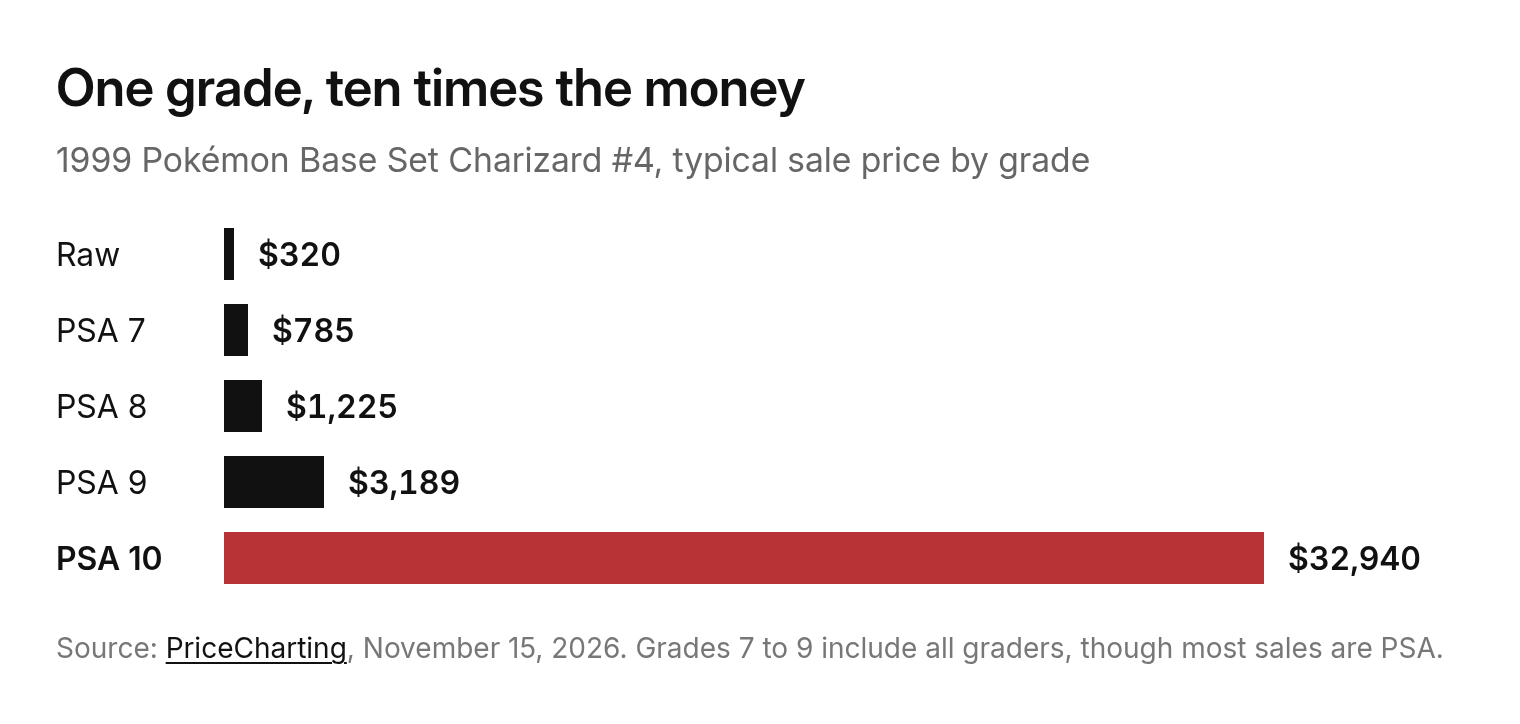
| Card | Raw | Grade 7 | Grade 8 | Grade 9 | PSA 10 |
|---|---|---|---|---|---|
| 1999 Pokémon Base Set Charizard #4 | $320 | $785 | $1,225 | $3,189 | $32,940 |
| 1989 Upper Deck Ken Griffey Jr. #1 | $102 | $124 | $150 | $410 | $5,052 |
| 2021 Evolving Skies Umbreon VMAX #215 | $1,816 | $1,669 | $1,765 | $1,859 | $3,541 |
PriceCharting and SportsCardsPro, November 15, 2026. The 7, 8 and 9 columns include all graders, though most sales are PSA.
The Griffey rookie is the starkest example. A PSA 9 sells for about four times an ungraded copy, and a PSA 10 for about 12 times a PSA 9. The Umbreon runs the other way: it’s valuable ungraded, and right now a 7 or an 8 actually sells for less than a raw copy, because so many copies grade higher.
What it costs to grade with PSA
PSA charges by service level, and each level caps the declared value of the card. These are November 2026 prices, and PSA changes them often.
| Service level | Price per card | Maximum value | Estimated turnaround |
|---|---|---|---|
| Value | $39.99 | $500 | 90 to 100 business days |
| Standard | $59.99 | $1,000 | 70 to 80 business days |
| Priority | $79.99 | $1,500 | 50 to 60 business days |
| Express | $199 | $2,500 | 20 to 30 business days |
| Super Express | $349 | $5,000 | 10 to 15 business days |
| Premier | $599 | $10,000 | 7 to 10 business days |
Higher levels run up to $4,999 a card for cards worth up to $250,000, and $9,999 or more above that. There’s no fee tied to the grade itself, but if a card comes back worth more than its level’s maximum, which usually happens because it graded well, PSA moves it up a level and bills you the difference.
How to check a PSA slab is real
Every PSA slab has a certification number on the label. Type it into psacard.com/cert and you should see the same card, the same grade and, for many recent slabs, photos of the card. If anything doesn’t match, walk away.
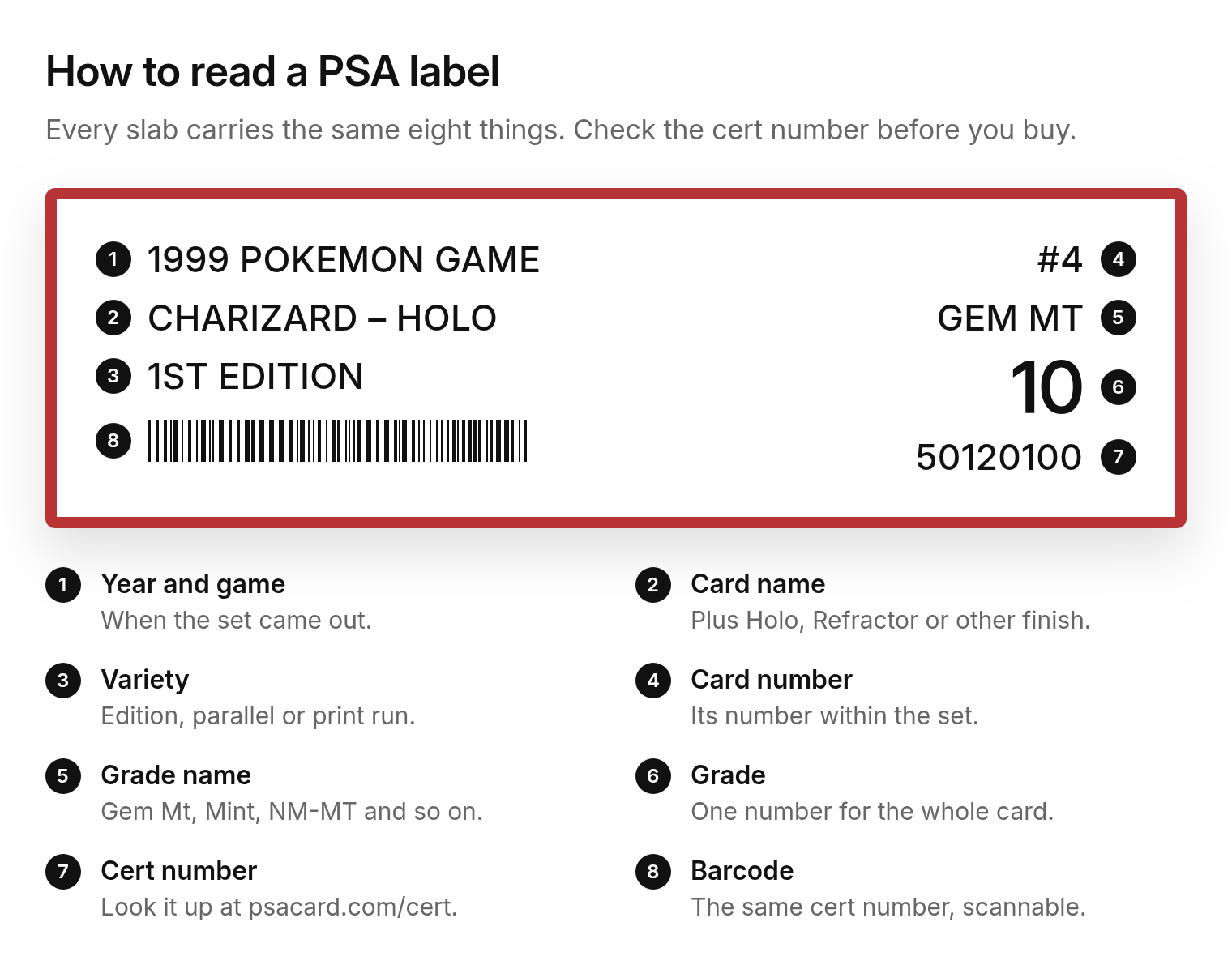
A matching number doesn’t prove much by itself. PSA warns that counterfeiters copy real certification numbers from public sources onto fake labels, and it recommends against buying slabs on sites like Craigslist, Mercari and OfferUp. Compare the card in the photos with the one in front of you, check the case hasn’t been opened and resealed, and buy expensive cards from sellers with a long record.
Is a PSA 10 a good investment?
It’s the grade most buyers want, and for older cards and modern cards with low gem rates it carries a large premium that has held up. For modern cards where most copies grade 10, the grade doesn’t make a card scarce, and the price comes down to how much people want the card itself.
What makes a PSA grade useful to an investor is that it gives the card a public condition record anyone can check, which is what lets you compare prices and build a portfolio in the first place. That’s why tash builds its indexes around PSA-graded cards, and our research paper makes the longer argument.
Prices are from public sales data and change daily. Past performance does not guarantee future results. Nothing in this post is financial advice. tash is pursuing SEC qualification under Regulation A, and qualification is in progress.
Sources
- Grade definitions, centering, half grades, qualifiers and N codes: PSA grading standards, checked via archived copies from January and November 2026; earlier centering ranges from a December 2024 archived copy
- Grading process: PSA FAQ; daily volume: PSA submission updates; lifetime total: About PSA
- Fees and turnaround: PSA trading card grading services, November 11, 2026
- Cert verification and counterfeit warning: PSA cert lookup
- 2025 grading volume: Sports Illustrated citing GemRate
- Gem rates: cllct via Yahoo Sports; Charizard population: TCGCharts; One Piece: GemRate, OP-13
- Prices (including Charizard sales from October 11 to November 7, 2026): PriceCharting Charizard, SportsCardsPro Griffey, PriceCharting Umbreon