Gem rate is the share of a card's graded copies that earn a 10. Here's how it's calculated, the terms around it, and why a low gem rate makes a PSA 10 worth so much more than a 9.
Gem rate is the share of a card's graded copies that earn a 10. Here's how it's calculated, the terms around it, and why a low gem rate makes a PSA 10 worth so much more than a 9.
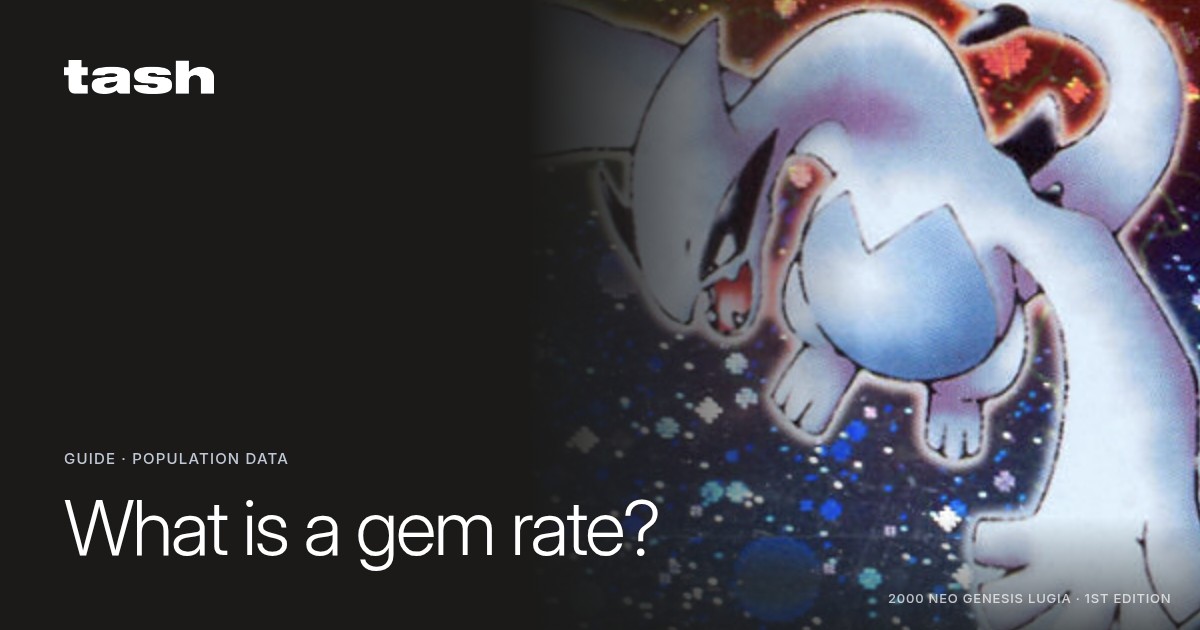
A card’s gem rate is the share of its graded copies that got the top grade. For PSA that’s the GEM-MT 10, so the gem rate is the number of PSA 10s divided by the total number of copies PSA has graded. If PSA has graded 1,000 copies of a card and 250 came back as 10s, the gem rate is 25%.
It tells you how hard a 10 is to get. And that, more than anything else, explains why a PSA 10 of one card sells for twice its PSA 9 while a PSA 10 of another sells for thirty times.
How it’s calculated
The inputs come from population reports, the public counts each grading company keeps of every copy it has graded at every grade. GemRate, one of the most widely used trackers, pulls together the reports from PSA, Beckett, SGC and CGC and updates them daily. For PSA, it counts only the 10 as a gem. For the other graders it lumps the top tiers together: a Beckett 9.5, 10 Pristine or 10 Black Label all count, as do an SGC 10 or 10 Pristine and a CGC 10, 10 Pristine or 10 Perfect.
For one grader’s gem rate, divide that grader’s gem count by its total graded count for the card. The same math works across a set, a year or a whole category, which is how the market-wide figures further down are built.
The terms around it
Population report. A grading company’s count of how many copies of a card it has graded at each grade. Usually shortened to “pop,” as in “the PSA 10 pop is 489.”
Pop 1. A card with only one copy at a given grade, usually the top one. Collectors pay heavily for these, because there’s no other copy at that grade to buy.
Gem Mint vs gem. “Gem Mint” is the name of a specific grade, such as PSA’s GEM-MT 10. “Gem” is looser shorthand for any card that reached a grader’s top tier, which at some companies includes grades above Gem Mint.
Pristine. A tier above Gem Mint that SGC, CGC and Beckett offer and PSA doesn’t. At SGC and CGC, Gem Mint is a 10 and Pristine is a 10 on a gold label. At Beckett, Gem Mint is a 9.5 and Pristine is a 10. The rarest Beckett Pristine 10, the Black Label, needs a 10 on all four of its subgrades.
10/9 multiple. The price of a PSA 10 divided by the price of a PSA 9 of the same card. It’s the quickest way to see what the market pays for the last step to the top.
Why a low gem rate means a bigger price jump
If almost every copy of a card grades 10, a 10 is just what that card normally gets, and buyers won’t pay much over a 9 for it. If only one copy in a few hundred makes it, the 10 is scarce next to the 9, and the price pulls away.
The table below covers 13 Pokémon cards, from 1999 Base Set holos to recent ultra-rares, using PSA population data and market prices from November 2026. Every card with a gem rate under 2.5% sells as a PSA 10 for at least eight times its PSA 9 price. Every card with a gem rate above 25% sells for between 1.8 and 4.2 times.
| Card | PSA 10s / PSA graded | Gem rate | PSA 9 | PSA 10 | 10/9 multiple |
|---|---|---|---|---|---|
| 1999 Base Set Charizard, Shadowless | 58 / 14,600 | 0.4% | $11,700 | $210,000 | 17.9x |
| 1999 Base Set Charizard, Unlimited | 489 / 105,662 | 0.5% | $3,000 | $35,770 | 11.9x |
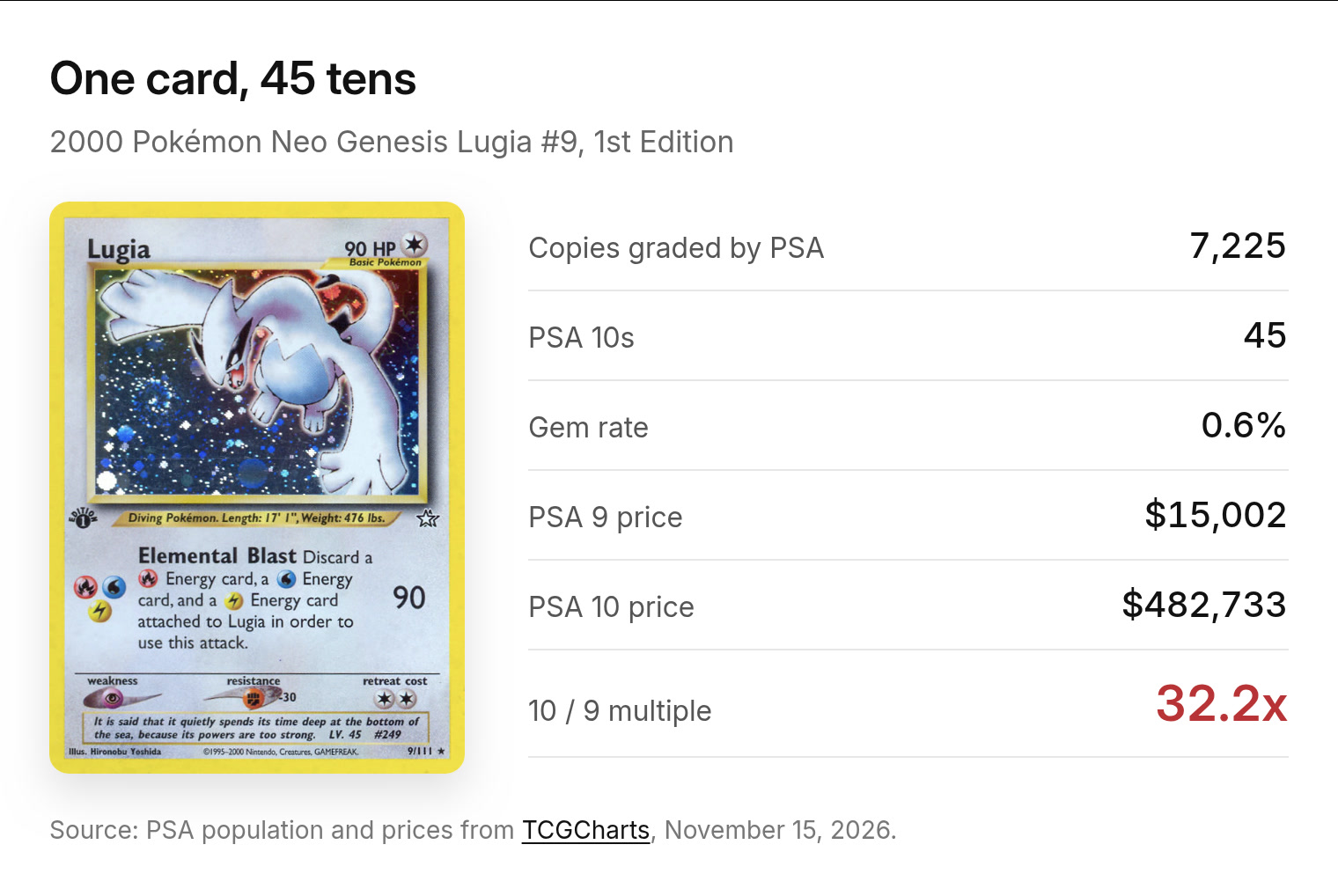
| 2000 Neo Genesis Lugia, 1st Edition | 45 / 7,225 | 0.6% | $15,002 | $482,733 | 32.2x |
| 1999 Base Set Charizard, 1st Edition | 123 / 5,427 | 2.3% | $84,174 | $1,380,000 | 16.4x |
| 2002 Neo Destiny Shining Charizard | 384 / 7,875 | 4.9% | $5,850 | $20,776 | 3.6x |
| 2023 Pokémon 151 Charizard ex #199 | 28,908 / 105,976 | 27.3% | $339 | $1,136 | 3.4x |
| 2025 Prismatic Evolutions Umbreon ex #161 | 6,740 / 22,536 | 29.9% | $993 | $4,175 | 4.2x |
| 2024 Paldean Fates Mew ex #232 | 16,803 / 51,469 | 32.6% | $710 | $2,115 | 3.0x |
| 2022 Lost Origin Giratina V #186 | 9,847 / 24,438 | 40.3% | $800 | $3,050 | 3.8x |
| 2019 Hidden Fates Charizard-GX SV49 | 9,781 / 20,025 | 48.8% | $650 | $1,350 | 2.1x |
| 2021 Fusion Strike Gengar VMAX #271 | 14,851 / 28,238 | 52.6% | $820 | $2,030 | 2.5x |
| 2021 Celebrations Charizard #4 | 36,620 / 62,204 | 58.9% | $185 | $460 | 2.5x |
| 2021 Evolving Skies Umbreon VMAX #215 | 21,917 / 31,734 | 69.1% | $1,970 | $3,585 | 1.8x |
Population and prices from TCGCharts, November 15, 2026. Gem rate uses PSA grades only, counting whole grades 1 to 10, so some rates run a few tenths of a point above the headline figure TCGCharts shows. Price guides don’t always agree: on the same day, PriceCharting had the Unlimited Charizard at $3,189 as a 9 and $32,940 as a PSA 10, a 10.3x multiple.
Sports cards follow the same pattern. A 1986 Fleer Michael Jordan rookie has a PSA gem rate of about 1.3%. Its PSA 10 sold for $396,500 in October 2026, while PSA 9s have been selling for roughly $44,000 to $48,000, a multiple of eight to nine. A 2018 Prizm Luka Doncic base rookie has more PSA 10s than PSA 9s, and its 10 sells for about two and a half times its 9.
It’s a rule of thumb, though, not a ranking. The 1st Edition Charizard gems more often than the Unlimited one and still carries a huge multiple, because people want the 1st Edition so badly at any grade. Gem rate tells you how scarce a 10 is. How much people want the card is a separate question, and it moves the price too.
What gem rates look like across the hobby
The biggest driver is age. Cards printed and stored in the last few years reach the graders in much better shape than cards that spent decades in binders and shoeboxes.
| Group | Gem rate | Period |
|---|---|---|
| All cards, all graders | 43% | first half of 2025 |
| Trading card games, all graders | 50% | first half of 2025 |
| Sports cards, all graders | 34% | first half of 2025 |
| Pokémon and other TCG cards from the 2020s, PSA | about 59% | first half of 2025 |
| Sports cards from the 2020s, PSA | 42% | mid-2025 |
| Sports cards from the 2010s, PSA | 35% | mid-2025 |
| Sports cards from the 2000s, PSA | under 20% | mid-2025 |
| Sports cards from the 1990s and earlier, PSA | teens or single digits | mid-2025 |
What a gem rate doesn’t tell you
A gem rate only covers the cards people chose to submit, not every copy ever printed. Collectors mostly send in the copies they expect to score well, so a modern card’s rate runs higher than it would if every pack were opened and graded.
Population reports also overcount. When someone cracks a card out of its case and resubmits it, the old entry often stays in the count. And a card that crosses from one grader to another can show up in both reports.
So read a gem rate as a guide to how scarce a 10 is among the copies actually on the market. For a buyer or a seller, that’s the number that counts anyway.
How tash uses it
Population data is one of the main inputs into how tash picks cards for its indexes. Our Rising Stars index, for example, only holds cards with a population under 250. For the longer argument on why public population counts make graded cards something you can invest in, read The Census Asset.
Nothing in this post is financial advice. tash is pursuing SEC qualification under Regulation A, and qualification is in progress.
Sources
- Gem rate method: GemRate documentation
- Card population and prices: TCGCharts, for example Base Set Charizard, accessed November 15, 2026
- Jordan and Doncic sales: Card Ladder, SportsCardsPro
- Market-wide gem rates: cllct via Yahoo Sports (July 2025), Cardlines (September 2025)
- Population report limits: Sports Collectors Daily