How graded trading cards compare with art, fine wine, watches and gold on 10-year returns, selling costs, drawdowns and US tax, written for investors who don't collect.
How graded trading cards compare with art, fine wine, watches and gold on 10-year returns, selling costs, drawdowns and US tax, written for investors who don't collect.
If you’ve never bought a trading card, the idea of holding one as an investment probably lands somewhere between a hobby and a joke. That was fair when cards cost a few dollars and nobody could agree on what condition a card was in. It’s harder to defend now that grading companies have certified more than 26 million cards in a single year, and every graded card has a public serial number, a grade and a population count anyone can look up.
So here are graded cards next to the four collectibles wealthy investors already own: art, fine wine, luxury watches and gold. We compare what each has returned over roughly the last decade, what it costs to sell, how far each has fallen from its recent peak and how the IRS taxes the gains. Cards don’t win every row, and we’ve left in the ones where they look worse.
Returns over the last decade
No one publishes a single index that measures all five the same way, so the figures below come from different providers with slightly different windows. Read the table as a rough picture of each market, not a race with a photo finish.
| Asset | Benchmark | Period | Return |
|---|---|---|---|
| Trading cards | Card Ladder CL50 | November 2016 to November 2026 | +587% |
| Pokémon cards | Card Ladder Pokémon index | November 2016 to November 2026 | about 96x |
| Art | Knight Frank art index | 10 years to Q4 2023 | +105% |
| Art | MM Art Index (CKGSB) | 10 years to 2024, annualized | −1.4% a year |
| Fine wine | Liv-ex Fine Wine 100 | 10 years to end-2025 | +34.1% |
| Watches | Knight Frank watch index | 10 years to Q4 2023 | +138% |
| Gold | LBMA price | end-2015 to November 2026 | +266% |
| US stocks | S&P 500 with dividends | 10 years to November 2026 | +308% |
The S&P 500 beat every collectible here except cards. Keep that in mind the next time someone tells you a passion asset “beats the market.” And look at the two art indexes, which don’t come close to agreeing: Knight Frank tracks top-end auction results, while the MM Art Index follows repeat sales of the same works. How an index is built changes its answer, and that goes for cards too. Timing matters as well: both Knight Frank figures come from its 2024 report, and its 2026 numbers are far weaker for art, with the best-performing art category up just 2.2% over ten years.
Card Ladder’s CL50, 50 cards the company picks to represent the market, went from 3,795 in November 2016 to 26,058 on November 15, 2026. That’s about 21% a year, against 15% for the S&P 500. Card Ladder’s broader Pokémon index, which tracks more than 9,400 cards, went from 1,496 to 143,968 over the same ten years, and more than quadrupled in the last twelve months alone.
Two warnings come with those numbers. The CL50 is a list of cards that matter today with their price history filled in backwards, so it leaves out cards that were hot in 2016 and have since faded. Nobody in 2016 knew which 50 cards to buy. And the ride was anything but smooth: the drawdown section below shows how far the index fell between 2021 and 2024.
What it costs to sell
Collectibles come with transaction costs stock investors rarely see, and those costs can matter more than a few points of annual return. A 25% round trip on an asset growing 8% a year takes three to four years to earn back.
| Asset | Typical cost to sell or buy |
|---|---|
| Trading cards | eBay takes 13.25% of the sale up to $7,500 and 2.35% above that, plus a per-order fee |
| Art | Sotheby’s and Christie’s both charge buyers 28% up to $2m, on top of the seller’s commission |
| Fine wine | merchant commissions vary, and UK bonded storage runs about £15 per case a year |
| Watches | dealers typically pay 70 to 90 cents on the dollar against market value, and even a longtime client’s trade-in may only get 80 to 85 cents |
| Gold | a one-ounce American Eagle costs roughly 4% to 5% over spot even at the cheapest dealers, and dealers buy back below spot |
Cards sit in the middle. An eBay fee is lower than an art auction premium but much higher than the spread on gold. The cost most investors miss is handling the physical object: every sale means shipping a slab, waiting to get paid and trusting a stranger. A vaulted card that changes hands without leaving the vault skips most of that.
How far each one has fallen
Every asset here has had a bad stretch since 2022, and the size of the drop says more about risk than the long-run return does.
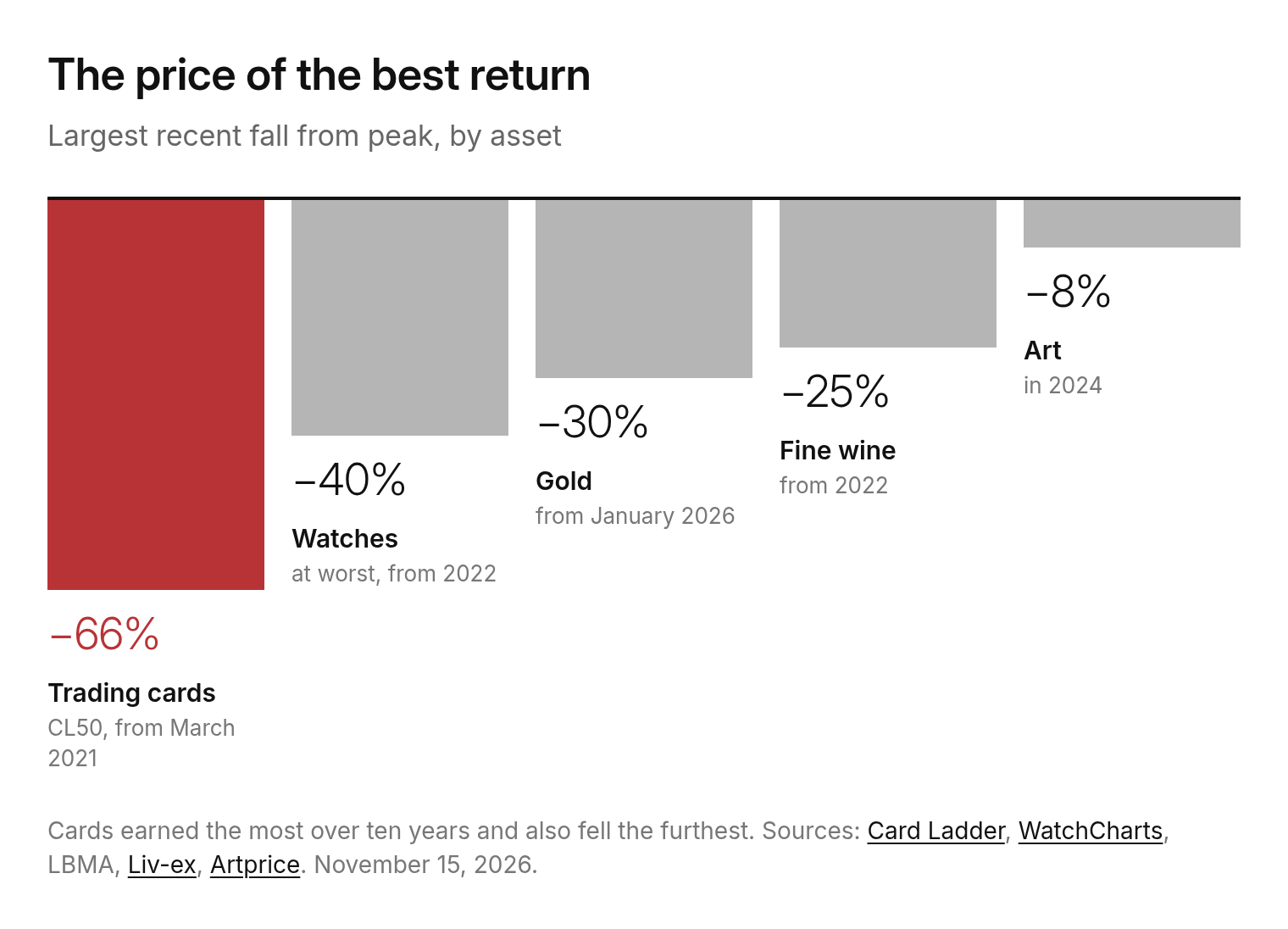
Cards fell the hardest. The CL50 dropped 66%, from a peak of 35,122 in March 2021 to 11,906 in December 2024. It rose about 45% in 2025 and another 45% so far in 2026, and is still about 26% below that peak. The Pokémon index fell a milder 27% over roughly the same period.
Fine wine is still about 25% below its 2022 peak on the Liv-ex 100, after losing another 2.5% in 2025. The WatchCharts watch index fell for 11 straight quarters after its April 2022 peak, down about 40% at its worst. It has risen for five quarters since and is up 8.3% on a year ago, but it’s still about 29% below that peak. Gold hit $5,589 an ounce in January 2026 and has since dropped about 30%, to around $3,880. Art looks steadiest on headline numbers, with the Artprice100 down 8.3% in 2024 and up 11.2% in 2025.
Cards had a sharper boom in 2020 and 2021 than anything else on this list, and a harder crash after it, which is what a market looks like when a lot of new money shows up at once. Anyone who bought the cards in the CL50 at the 2021 top is still underwater five years later. Card prices have still come back faster than watches or wine, helped by a huge rise in grading volume and by Pokémon in particular, which made up about 16.1 million of the cards graded in 2025.
Market size and liquidity
A small market can swing a long way on a few big sales. The global art market did $59.6bn in sales in 2025, according to the Art Basel and UBS report, and the pre-owned watch market came in around $16.7bn. Estimates for trading cards run anywhere from $8bn to $30bn depending on whether you count new packs, raw cards or only graded sales, so we wouldn’t lean on any one of them. Activity is easier to pin down. Grading companies certified about 26.8 million cards in 2025, up 32% on 2024, and online card sales hit $305m in June 2025 alone, a monthly record at the time.
Liquidity is where cards and art part ways. A painting might come to auction once every decade or two, so its price in between is a guess. A popular graded card, like a PSA 10 of a modern Pokémon card, can sell several times a week, and every one of those sales is public. The market is smaller than art’s, but its price record is more frequent and easier to check than anything art or rare wine can offer.
Authentication and condition
Every one of these assets needs a way to answer two questions: is it real, and what state is it in?
Art relies on provenance records and expert opinion, which are expensive and occasionally wrong. Wine depends on storage history, and a badly kept bottle can be worth a fraction of one kept in bond. Watches need service records and original parts. Gold is the easy one: an assay or a recognized mint mark settles it.
Graded cards are closer to gold than to art. A company such as PSA examines the card, seals it in a tamper-evident case and records the result under a serial number in a public database. Grading isn’t perfect, since graders can disagree and fake slabs exist, but a buyer can check a card’s grade and population count online in seconds. PSA alone handled about 72% of the cards graded in 2025, which makes its grade the closest thing the hobby has to a standard.
Tax in the US
The IRS treats all five much the same. Net long-term gains on collectibles are taxed at up to 28% federally. The IRS definition names art, gold bullion and alcoholic beverages such as wine, and cards and watches are generally treated as collectibles too. Long-term gains on stocks top out at 20%. That eight-point gap is easy to miss, and it applies to one card the same as a hundred. Talk to a tax adviser about your own situation, because state taxes and the net investment income tax can change the total.
Comparison table
| Trading cards | Art | Fine wine | Watches | Gold | |
|---|---|---|---|---|---|
| 10-year return | +587% (CL50) | mixed, depends on index | +34% (Liv-ex 100) | +138% to 2023, then down about 40% before recovering | +266% |
| Largest recent drop | −66% from March 2021 peak (CL50) | −8% in 2024 | about −25% from 2022 peak | about −40% at worst, −29% now, from 2022 peak | about −30% from Jan 2026 peak |
| Cost to sell | about 13% on eBay | 28% buyer’s premium plus seller’s fee | merchant commission plus storage | dealers pay 10% to 30% below market | a few percent over and under spot |
| How often prices update | daily for popular cards | rarely | weekly to monthly | daily for popular models | continuously |
| Condition standard | grading company and public database | expert opinion and provenance | storage history | service history and parts | assay and mint mark |
| US long-term tax rate | up to 28% | up to 28% | up to 28% | up to 28% | up to 28% |
Where cards fit
Cards don’t replace stocks. The CL50 beat the S&P 500 over ten years, but it lost two-thirds of its value along the way, and few stock investors would have held on through that. What cards do have is public prices, a widely used condition standard and a lot of buyers, which is more than art or wine can say. What they don’t have is a long track record as an asset, and their history so far is one of sharp, hype-driven swings.
If you want exposure without learning the hobby, buying single cards is the hardest way in. One card’s price rides on one player, one grade and one population count. A spread of cards smooths that out the same way an index fund smooths out the risk of owning one stock. That’s how tash approaches it with its indexes, and our research paper explains in more detail why we think graded cards can be treated as an asset.
Past performance does not guarantee future results. Nothing in this post is financial or tax advice, and it is not an offer to buy or sell any security. tash is pursuing SEC qualification under Regulation A, and qualification is in progress.
Sources
- Card Ladder CL50 index and Pokémon index, daily values read November 15, 2026
- Knight Frank Luxury Investment Index (April 2026); The Wealth Report 2024, page 62; 2026 art figure via Decanter
- MM Art Index, Spring 2025 report and Artprice100
- Liv-ex figures via Decanter and Liv-ex
- WatchCharts index via Forbes, October 2026 and May 2024 (archived copies)
- Watch dealer prices via Hilco Global (August 2026) and WatchPro (archived copy)
- Watch market via EveryWatch / Europa Star
- Gold prices via Kitco; S&P 500 via Chartrow
- Gold coin premiums via Gold and Silver Saver
- Auction premiums via Christie’s, Antiques Trade Gazette and The Art Newspaper
- Art Basel and UBS Art Market Report 2026
- Grading volume via Sports Illustrated and cllct via Yahoo Sports, both citing GemRate
- IRS Topic 409 and IRS Publication 550